



















Nicholson Clinic is pleased to announce Dr. Thomas Roshek has been named to the Texas Super Doctors® list for 2021. This is the fourth consecutive year Dr. Roshek has been given this award, from 2018-2021. Prior to this, Dr. Roshek was recognized as a Texas Super Doctors® Rising Star from 2014-2016, which specifically recognizes younger physicians who have been fully-licensed approximately 10 years or less. While approximately 5 percent of the doctors within the respective state or region are named to Super Doctors, no more than 2.5 percent are named to the Rising Stars list.
To be listed in Super Doctors is a unique distinction as doctors are nominated and selected for this honor by their peers in the medical field.
“It is an honor to have once again received this recognition from my peers,” said Dr. Roshek. “My number one goal is always to provide excellent care for my patients. At Nicholson Clinic, we do more than just treat weight loss surgery patients; we build relationships and I believe that’s what really sets us apart.”
In addition to being named to the Texas Super Doctors list for four years and the Texas Super Doctors Rising Star list for three years, Dr. Roshek has won numerous other awards and accolades for his leadership in bariatric surgery and his dedication to patient care. His resume of awards and recognitions also include:
●One of D Magazine’s “Best Doctors in Dallas for 2013, 2017, 2019-2021.
●One of D Magazine’s Best Doctors in Collin County for 2013, 2016-2018, 2020-2021.
●Voted to Living Well Magazine’s “Top Docs” list in Bariatric and General Surgeon category for 2019-2021.
●The Nicholson Clinic team of surgeons were voted Living Magazine’s Best of Three-Eighty North for 2016 and 2017 and Best of Frisco/Plano for 2020 and 2021.
●Society of Laparoendoscopic Surgeons Resident Achievement Award for 2009.
●Tufts University School of Medicine Excellence in Teaching Award.
The Super Doctors honor reinforces Dr. Roshek’s commitment to the weight loss community in general and specifically, in his long-standing dedication to his parents. The award was published in the December 2021 issue of Texas Monthly magazine.
Did you have LAP-BAND® surgery and want to know when removal is required? You are not alone! This question is often asked by patients who opt-in for this surgery. Your LAP-BAND® is working fine if you experience prolonged satiety, you have no complications and have lost an average of 50% of your excess weight after one to five years. But if your LAP-BAND® is causing you issues; you may want to have it evaluated. This article provides answers to LAP-BAND® concerns and other related questions you likely have.
When Should LAP-BAND® Be Adjusted?
Patients typically should be seen monthly or bimonthly during the first year after LAP-BAND® placement. Your surgeon will help figure out when you need an adjustment.
More fluid will be added to your band if you:
- Do not obtain optimal weight loss
- Are hungry
- Are craving for food
During a LAP-BAND® fill session, the saline solution in the gastric band is adjusted using the external port in the band device. The more saline added, the tighter the band and the narrower the passage. Thus, making it harder for food to pass. The goal of the fill is to find the proper amount of fluid that aids in weight loss yet still provides proper nutrition for the patient.
When Is Fluid Removal Recommended?
Fluid removal is done if you are not getting proper nutrition and have symptoms like:
- Night cough
- Difficulty swallowing
- Regurgitation
What Are Symptoms of a LAP-BAND® Complication?
It’s important to have your LAP-BAND® evaluated at minimum yearly to ensure your LAP-BAND® is not only functioning properly but also ensure there are no complications such as band erosion, band migration/slippage, band infection, gastric prolapse, esophageal and/or pouch dilation.
Symptoms of a complication include:
- Nausea
- Vomiting
- Reflux (Heartburn)
- Abdominal pain/discomfort
- Constipation
- Difficulty tolerating solid foods
- Food trapping
- Difficulty swallowing
Bottom Line
If LAP-BAND® didn’t perform as well as you hoped or if you have been experiencing discomfort, then you may want to explore switching over from the LAP-BAND® to the Gastric Sleeve or Gastric Bypass to reach your desired weight loss goals. In a band revision, we DO NOT CHARGE for the band removal like many other bariatric surgeons do. Nicholson Clinic never charges additional surgeon fees for a band removal when revising to a sleeve or bypass during the same surgical session. For cost and insurance coverage for the removal, contact the Nicholson Clinic.

Bariatric surgery, which is a technical term for the different types of weight loss surgeries, is performed by a bariatric surgeon. What makes a surgeon qualified to perform these procedures? Continue reading to learn more.
What Makes A Doctor Qualified To Perform Bariatric Surgery?
Bariatric surgeons specialize in advanced, minimally invasive bariatric procedures and have in-depth training with laparoscopic equipment. Bariatric surgeons often begin as general surgeons; and some continue to offer general abdominal surgery procedures such as gallbladder removal, hiatal hernia repair, and abdominal wall hernia repair. After finishing medical school, doctors spend a minimum of three years in residency obtaining experience in surgery. Physicians spend sufficient time training with established surgeons and engage in a bariatric surgery fellowship to become bariatric surgeons. Through the American Board of Obesity, they can become board certified. Ideally, the best bariatric surgeons are board certified in General Surgery by the American Board of Surgery, a Fellow of the American College of Surgeons (FACS), and a member of the American Society for Metabolic and Bariatric Surgery (ASMBS) and the Society of American Gastrointestinal and Endoscopic Surgeons (SAGES).
More Details About Bariatric Surgery
The primary reason for bariatric surgery is to reduce the size of the stomach, limiting a person’s capacity for food intake. This surgery is introduced when other options to lose weight have been explored with no success. There are different types of bariatric surgery performed by trained and experienced bariatric surgeons. The three most common procedures are:
- Gastric Sleeve Procedure
- Gastric Bypass Surgery
- LAP-BAND Surgery
Your doctor will discuss which procedure would be the most effective for you based on your health and goals. All these must be performed by trained bariatric surgeons with years of quality experience.
Final Thoughts
Are you ready to have bariatric surgery? Finding a credentialed surgeon with years of experience is key as it ensures the highest standards, best outcomes and lowest complication rates. Keep in mind that credentials speak to the quality of both the surgeon and the hospital at which you will have your surgery. Find out if your surgeon is qualified by the Metabolic and Bariatric Surgery Accreditation and Quality Improvement Program (MBSAQIP). Insurance companies, such as Blue Cross Blue Shield may also award distinctions to the best hospitals in their network.
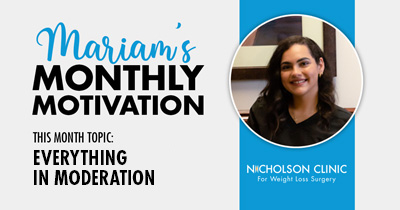
Hello everyone and welcome to my second blog post! If you don’t know who I am, let me introduce myself. My name is Mariam and I am a patient educator here at Nicholson Clinic. I am also a weight loss surgery patient myself, currently 10 months post-op VSG. This month’s topic is, “Everything in Moderation” and I am very excited to talk about this one.
The first thing I want to talk about is restriction and how it can be both good and bad. The surgery itself is restrictive in nature. If you had the sleeve, your stomach size and capacity is restricted and with the bypass, your intestinal tract is rerouted thereby restricting your nutrition intake. In this sense, the restriction is good allowing patients a chance to lose weight that they tried so hard to lose for years. Where restriction can become an issue is habits developed after surgery. I always tell patients when they ask what my motto is in regards to weight loss and that is, I aim to eat more high-quality foods. Notice how I aim to add more food rather than focus on taking out any foods.
Imagine this, you make a reasonable income and 95 percent of the time, you’re very smart with your money. You drive a sensible car with good gas mileage, own a humble home, etc., but you never treat yourself. You never let yourself spend money on something that would be beneficial to your mental health like an occasional spa day, going out to eat with friends, or getting that six dollar Starbucks coffee you want because you’re trying to save money (or stay on track in regards to weight loss). Does that sound very enjoyable let alone sustainable?
I stopped dieting when I chose to have this surgery and changed my mindset into one where this became a lifestyle change, not something temporary. In that sense, I knew that if I was going to be consistent with this new way of eating and living, it would have to be realistic for me. So, if I wanted to eat out with my friends every once in a while, or try the new snack that came out, I was going to. But I wouldn’t let that get me off track or make it a habit.
Where I see most people going wrong is that they let that treat snowball. So, in the last scenario, if the person continuously made high dollar purchases, would he still have all that money? No, his money would go down just like a patient who chose to continuously eat high calorie foods weight would go up.
It may be a silly scenario, but I really hope you all understand what I’m trying to get at in that it is okay to have an occasional treat. It is not okay, on the other hand, to make it common habit. This is something I have to keep in mind on my own journey because I know that if I continuously tell myself, “No, you can’t have that one cookie, you’re on a diet” that I’ll end up eating four later due to creating that extreme restriction.
So, that is fine advice and all but how do you make it common practice and incorporate it into your lifestyle? The first thing is taking “good” and “bad” labels off food. There is no good or bad food. All food serves a purpose to your body, one type is just more nourishing.
I knew that with a smaller stomach capacity, I would really have to maximize every bite and prioritize certain food groups like proteins. Bread, for example, swells in the stomach and makes me very full to where I can’t get in enough protein or vegetables. Does that mean bread or carbs in general are bad or that I will never eat it again? Absolutely not, multigrain bread or complex carbs are necessary in a rounded diet, just in smaller amounts to allow you to prioritize your protein intake.
My biggest takeaway is that weight loss is about what you do 95 percent of the time. Working out once won’t make you “skinny” in the same way that one bad meal won’t make you “fat.” And if you get off track, just know it happens to the best of us, it definitely did for me. All you can do is get right back to it. Add more nutritious meals to your diet and remember your goal. You’ve got this and don’t forget, everything in moderation!

Are you considering gastric sleeve surgery? It is normal to have safety concerns for gastric sleeve or any type of surgery for that matter. With the improvement of surgical techniques, the gastric sleeve has become an overall effective and very safe bariatric surgical procedure.
Complications Of Gastric Sleeve Surgery
Researchers discovered that gastric sleeve surgeries produced the lowest complication rate, 0.96 percent, when compared with gastric bypass and gastric banding based on a Stanford university study of approximately 270,000 patients. Furthermore, the 30-day mortality rate for this procedure was found to be very low at 0.08 percent.
As with any major surgery, sleeve gastrectomy may pose potential health risks, both in the short term and long term.
Risks associated with sleeve gastrectomy may include:
- Excessive bleeding
- Infection
- Adverse reactions to anesthesia
- Blood clots
- Lung or breathing problems
- Leaks from the cut edge of the stomach
Longer term risks and complications of sleeve gastrectomy surgery may include:
- Gastrointestinal obstruction
- Hernias
- Gastroesophageal reflux
- Low blood sugar (hypoglycemia)
- Malnutrition
- Vomiting
Why should you make the decision to have gastric sleeve surgery over remaining obese? Obesity-related conditions such as diabetes, hypertension, sleep apnea, fatty liver disease, joint disease, GERD, heart disease, infertility and even certain types of cancer can put your body at a significantly higher risk than surgery, particularly gastric sleeve, which is considered very safe.
Conclusion
Undoubtedly, gastric sleeve surgery is a safe procedure for obesity. Gastric sleeve surgery is quick, and scarring is highly minimized. Most patients can usually go home the same day of the surgery.
But remember, you must also be willing to make permanent changes to lead a healthier lifestyle. You may be required to participate in long-term follow-up plans that include monitoring your nutrition, your lifestyle and behavior, and your medical conditions.
Need further information or want to be sure if this procedure is right for you? Call our weight loss surgeons today!

By Mariam Gayed, MA, Nicholson Clinic Patient Educator
Hello everyone and welcome to my first blog post! Every month I will be discussing a different topic pertaining to weight loss surgery. This first topic is one that is incredibly important but often not discussed enough and that is, the mental aspect of bariatric surgery.
As some of you may know, I was sleeved in January of this year before meeting Dr. Nicholson and his wonderful team. The physical changes to my body were discussed in detail by my surgeon but no mention of the mental side was made so honestly, I didn’t know what to expect and did not prepare myself as much as I should have.
I want to start by saying one thing we all have probably heard as bariatric patients and I’ll go on to explain it. Bariatric surgery is only a tool, not a magic cure. What I mean by that is, if you put it into your mind that this surgery will do all the work for you, put simply, you are setting yourself up for failure. A mistake I made early on.
I thought that no matter what mistake I made whether that be dietary or exercise based, my sleeve would save me so if I made bad food choices it would be fine since I had less than half a stomach. Boy was I wrong! I quickly learned that if I didn’t control what I put in my mouth, I would become a statistic.
I was so serious about making this change early on in my surgery that I put everything in my life on the backburner that could wait and really worked on myself. I want to stress the importance of putting YOU first and doing everything in your power to make this surgery work for you.
During this time, I worked on correcting my mindset and mentality, as well as healing my broken relationship with food. I no longer lived to eat but rather now eat to live. Don’t get me wrong, I’m still a huge foodie but now I eat to nourish my body before anything else. This was not an overnight fix and took months of “therapy” with myself and this is something I believe everyone should do because if we all had stellar eating habits, we would not have needed this surgery in the first place but we are all human and make mistakes, mistakes that we can fix with time and effort.
The next aspect I want to discuss is support. Firstly, whether you choose to tell people about your surgery or not is fully your choice. Do not feel as though you have to. I chose only to tell my parents and now all of you.
Secondly, know that if you feel like you’re going through this alone because your family doesn’t support your decision, you’re not. You have me and a whole team at the clinic to be there for you every step of the way. That being said, I know it’s difficult feeling like you have no support from the people you want it from the most but you will become your biggest supporter over time if you haven’t already. I believe in every one of you and genuinely want you all to succeed. It’s your turn to believe in yourself the same way.
Now let’s talk about some unexpected mental effects that occurred to me after surgery. The most obvious being the difficulty adapting to a whole new way of eating that differs so greatly from the way we’ve been eating our whole life. It’s okay to grieve your old lifestyle but it’s not okay to linger there.
Take some time to realize what you’re feeling and then work on healing your relationship with food and building healthy habits to carry you through this journey. And on that note, if you are farther out and feel like you’re slipping into old habits, reach out to a nutritionist. You are not any less of a person by doing this and taking your health back into your own hands.
Then there’s the simpler changes along this journey that you may not have realized would take such a toll like new unexpected attention or people treating you differently at different weights, or body dysmorphia and struggling to see yourself in your new body (something even I struggle with).
I could go on and on about the little things that aren’t discussed but I’ll keep it short and say, you were the same person before weight loss surgery as you are now. Those issues you had before having surgery do not magically disappear afterwards. It takes commitment from you to choose to be successful and put your health number one in your life. This journey is such an empowering one, but it comes with its challenges. Take it one day at a time and remember, tomorrow’s a new day.
Alright, that’s a wrap on blog one. I hope you all enjoyed it and I will be hosting a Facebook Live to further discuss everything I’ve touched on in this blog a week from today. If you have any questions or anything you want me to specifically discuss in the live pertaining to this topic, please email me at mariam@nicholsonclinic.com. Good luck on your journey!

You’ve taken a huge leap in deciding to have weight loss surgery. It isn’t uncommon for patients to spend a year or more just considering surgery and doing their research, and select a bariatric surgeon before making the decision to finally undergo bariatric surgery.
Take a moment to recognize how monumental that decision is, and celebrate the fact that you’re deciding to improve your health and your quality of life, not only for yourself but for those you love as well.
Now that you’ve decided to get help losing weight, it’s time to choose a bariatric surgeon. This next step can be overwhelming as you do your homework on weight loss surgery surgeons and choose the surgeon who is the best fit for you. ObesityHelp makes your research easier to check out surgeons and their information. Here are eight key things to consider when choosing a bariatric surgeon.
8 Things To Do To Research and Select A Bariatric Surgeon
1. Research the Surgeon’s Credentials
Finding a credentialed surgeon is key as it ensures the highest standards, best outcomes, continued training and education, research, and innovation on the latest advancements.
Your surgeon should be:
- Board-certified in General Surgery by the American Board of Surgery and a specialist in multiple advanced bariatric procedures.
- An active member or Fellow of several organizations, including the American College of Surgeons (FACS), American Society for Metabolic and Bariatric Surgery (ASMBS), and Society of American Gastrointestinal and Endoscopic Surgeons (SAGES).
Other qualifications to consider include whether the surgeon teaches and/or trains other surgeons at national conferences or in the operating room, as well as the surgeon’s participation in research and contributions to scholarly articles.
Keep in mind that credentials speak to the quality of both the surgeon and the hospital at which you will have your surgery. Find out if your surgeon is qualified by the Metabolic and Bariatric Surgery Accreditation and Quality Improvement Program (MBSAQIP). Insurance companies, such as Blue Cross Blue Shield may also award distinctions to the best hospitals in their network.
2. Consider the Doctor’s Experience
Experience and credentials may go hand-in-hand, but they really are two separate factors to consider. Experience matters when it comes to complex procedures such as bariatric surgery and doesn’t necessarily mean how many years a surgeon has been practicing.
Some surgeons only specialize in a certain procedure or perhaps have a narrow focus. It’s better to have a surgeon who specializes in a multitude of minimally invasive bariatric and abdominal procedures, so they know how to handle a variety of abdominal issues. And some might only do a small quantity each year — the volume of surgeries is key! When considering a surgeon’s experience, look for:
- Years in practice
- Number of surgeries
- Wide variety of procedures and techniques
- Low complication rates
3. Research Hospital or Surgery Center Quality
The facility where the surgeon treats patients is another important aspect to consider. Do your research on the quality of the hospital or surgery center where you might be having surgery.
Hospitals and surgery centers with the highest standards for bariatric surgery may have accreditation through the Metabolic and Bariatric Surgery Accreditation and Quality Improvement Program (MBSAQIP).
A bariatric surgical center achieves accreditation following a rigorous review process during which it proves that it can maintain certain physical resources, human resources, and standards of practice. All accredited centers report their outcomes to the MBSAQIP database.
4. Ask for Referrals
Start by putting together a referral list from peers or community recognition, family and friends and even testimonials from past patients. Peer reviews and recognitions published through various sources can be another great source.
Start by searching “Best of” lists in your area. These lists are often published in local magazines, and designations are typically selected through nominations, votes, and input from other acclaimed physicians in the area.
Also, consider referrals from your own doctors, such as your primary care physician or a specialty doctor. Many bariatric patients have obesity-related health conditions and are referred to surgeons by cardiologists, gastroenterologists, endocrinologists, etc.
5. Talk to Your Friends and Family
Many bariatric patients have had friends or family members who have previously had weight loss surgery. Talk to them about their experience, both good and bad.
Getting an opinion from someone who has been on the same journey and knows what it’s like to go through the pre- and post-op process can be invaluable. If you do not have a friend or family member who has a positive weight loss surgery experience, search for testimonials from past patients of the doctors on your narrowed-down list. Community websites and Facebook groups focused on weight loss surgery can also be helpful resources.
6. Evaluate the Surgeon’s Patient Support Offerings
Ongoing patient support is a significant piece of the process. A patient’s success is not just about the surgery; it’s about all the support that should come with it — before, during, and after surgery.
Find a surgeon who offers pre-op, post-op, and maintenance support to patients. Support options may include nutrition counseling, fitness coaching, and psychological support groups. Some practices offer both in-person and virtual support.
7. Know What Your Insurance Covers
If you have bariatric coverage and plan to use insurance to help cover the cost of bariatric surgery, then you will need to choose a physician and facility that is in-network with your insurance plan to pay the least out-of-pocket for your surgery and care.
If you are not comfortable with the surgeons or facilities that participate in your insurance plan, you might prefer to go the self-pay route instead. Many practices offer affordable financing through companies such as Care Credit or Prosper Healthcare Lending.
8. Trust Your Instincts
Finally, consider your personal comfort level and find a doctor with whom you connect. This is why the initial consultation with a doctor is so important. You should feel comfortable asking questions and have a doctor who will customize a program for you.
Bariatric surgery is never a one-size-fits-all approach, and you should feel good about your decision and your treatment option. In addition to the doctor-patient connection, consider the other medical providers and staff members you work with along the way, including nurses, physician assistants, medical assistants, nutritionists, etc.
Summary: How to Research and Select a Bariatric Surgeon
Consider it a long-term relationship as you’ll be working with your surgeon and their medical staff leading up to surgery for the actual procedure, but also long after for follow-up care and support to ensure your health and optimal results.
About the Author
Dr. Nick Nicholson is one of the nation’s leading bariatric surgeons. He’s been performing weight loss surgery since 2001 and has helped patients from ALL 50 states and 11 countries. He leads a team of top surgeons, specializing in Sleeve Gastrectomy, Gastric Bypass, LAP-BAND, Revisions, Gastric Balloon, and abdominal cosmetic surgery after weight loss. He practices out of the Nicholson Clinic for Weight Loss Surgery. Read more articles by Dr. Nick Nicholson!

Bariatric surgery is a critical undertaking — emotionally, physically, and financially. Without health insurance, weight loss surgery in Texas may seem insurmountable to some. So, to understand the beginning stages of having bariatric surgery, it is essential to know if — and how — insurance companies help financially.
Does Insurance Cover Weight Loss Surgery In Texas?
Yes, most insurance companies will cover most weight loss surgeries. The Nicholson Clinic for Weight Loss Surgery accepts and files most major insurance plans. These bariatric surgeries include:
- Gastric bypass
- Gastric Sleeve
- LAP-BAND® Surgery
How Do You Get Bariatric Surgery Covered By Insurance?
Nicholson Clinic for Weight Loss Surgery’s team of insurance specialists will help you easily manage the process, by working directly with your insurance provider to acquire approval. In many cases, bariatric surgery is considered a medical necessity and is at least partially covered by most insurance companies, provided the patient meets their requirements.
To get your bariatric surgery covered by your insurance, you might have to meet all or most of these criteria:
- Diagnosis of morbid obesity
- Have a Body Mass Index (BMI) over 40 – OR – a BMI over 35 with one or more comorbidity
- Must be above 18 years of age
- Not a smoker or have quit before the procedure
- Emotionally fit for the surgery
- Willingness to stick to the weight loss plan outlined by the insurance company
Coverage for your weight loss surgery is dependent on your specific insurance plan, however your Insurance Advocate will work with you and your insurance provider to help you minimize your out-of-pocket expense and maximize coverage for your procedure.
In a situation whereby your insurance doesn’t cover bariatric surgery, there are other alternatives such as financing options that can make weight loss surgery affordable.
Bottom Line
If you have questions regarding weight loss surgery or find the whole process intimidating, schedule a consultation with one of our experienced bariatric surgeons today to get answers to all your questions regarding health insurance and weight loss surgery.

Life Before Surgery
“Life before my surgery was getting really hard. My feet and legs were always hurting. My blood pressure, acid reflux, and prediabetes were just making life miserable, I just felt so lethargic and “yucky” all the time. I was always embarrassed to go anywhere, I was so self conscious of how I looked so I just started to stay home. I couldn’t play with my kids, I couldn’t move around very well, it was just hard all around.”
The Nicholson Clinic Experience
“The process with The Nicholson Clinic was wonderful! They made everything so easy. They answered all my questions about the surgery, the healing process, the life long changes that I needed to make and everything in-between. They were all so kind and knowledgeable. Dr. Roshek was very honest and confident in this surgery and how it would go. It went perfectly and the healing was quick!
“I had my sleeve surgery at The Surgicare Baylor in Garland, they were amazing! They took such great care of me, informed my family of everything I needed to know for when I got home and just provided excellent care.”

Life After Surgery
“This is the BEST thing I could have done for myself! I feel AMAZING! I’m confident, I go places, I play with my kids and we do all kinds of fun things now. My feet and legs no longer hurt, my acid reflux and pre diabetes is all gone. I feel like a new person! I would do it again a million times! I had surgery 7/09/2020 I have lost a total of 115 pounds, just amazing!”

Did you know that if you have a Flexible Spending Account (FSA), Health Savings Account (HSA) or Health Reimbursement Account (HRA), you can use those funds to pay for weight loss surgery? If you’ve been considering bariatric surgery, but have been concerned about the cost because your insurance doesn’t cover it, or perhaps you have a high deductible, your FSA, HSA or HRA can help cover the expense — and it’s tax free!
FSA, HSA and HRA funds are taken out of your paycheck pretax, so not only will you not pay taxes on those funds used to cover medical expenses like weight loss surgery, but making a contribution to an FSA/HSA/HRA also lowers your taxable income
Changes to FSA for 2021
If your employer offers a flexible spending plan for healthcare expenses, you can use this pre-tax income to pay for a variety of healthcare costs, including weight loss programs and bariatric surgery. The 2021 FSA maximum contribution remains at $2,750.
Flexible Spending Accounts are different from Health Savings Accounts in that typically you must use the funds in your account each year, or you will lose them. In previous years, employers were allowed to extend a $500 rollover of FSA funds from one year to the next, or a two-and-a-half month grace period to use the previous year’s FSA dollars (but are not required to offer the rollover or grace period). For 2021, regardless of which type of FSA you have, the Consolidated Appropriations Act — signed into law in December — temporarily allows you to roll over any unused funds. (That is, if your company opts in.)
If you are unsure how your FSA plan is set up, talk to your employer’s human resources department to find out which, if any, extensions apply to you.
Save Even More at Nicholson Clinic
Nicholson Clinic is dedicated to helping prevent finances from limiting any patient who desires life-changing weight loss surgery. We are proud to offer one of the lowest self-pay prices in town, along with a number of payment options, including cash pay, payment plans and financing for as low as $248/month.
Few bariatric practices include everything in one low price, from your initial consult to your post-op follow-up visits for life! And our pricing is significantly lower than the national average. (Read more about payments and pricing on our website.)
If you’ve been on the fence about bariatric surgery and you have remaining unused FSA funds, it’s not too late to get scheduled for surgery. Contact us today with any questions or to get the process started.