

















We are thrilled to announce that once again, Nicholson Clinic surgeons, Nick Nicholson, MD, Brian Long, MD and Thomas Roshek, MD have been named “Best Doctors” in Collin County by D Magazine.
The selection process for this honor is a rigorous one as it begins with peer nomination and ends with online voting. To be recognized by your peers as a top surgeon in the Dallas-Ft. Worth Metroplex is no small feat, and we are so proud to celebrate our incredible Nicholson Clinic surgeons and grateful to all those who nominated and voted for our doctors!
This recognition isn’t a first for our surgeons, check out their D Magazine resumes for Collin County:
- Dr. Nicholson – One of D Magazine’s “Best Doctors” in Collin County, 2011-2016, 2018-2022
- Dr. Long – Voted one of D Magazine’s “Best Doctors” in Collin County 2019-2022
- Dr. Roshek – One of D Magazine’s Best Doctors in Collin County for 2013, 2016-2018, 2020-2022
Over the last two decades, Nicholson Clinic, led by founder Dr. Nick Nicholson, has worked to become a national leader in bariatric surgery. The distinction by D Magazine is a testament to the fact that Nicholson Clinic’s excellence in patient care is recognized not only by our patients but by other physicians in the area.
“We are medical professionals who are not only committed to the highest standards of surgical technique but wholly committed to excellence in patient care,” says Dr. Nicholson, founder and lead surgeon at the Nicholson Clinic. It is with this commitment that Nicholson Clinic has helped more than 25,000 patients from across the country and around the world achieve their health goals.
Each of our surgeons is focused on long-term results for their patients and has seen countless numbers of cases entirely reverse weight-related illnesses. Nicholson Clinic patients receive ongoing support through a variety of channels, including access to clinical psychologists, nutritionists, fitness and online support groups. Our end goal is to help our patients adjust to a long-lasting healthy lifestyle.
Dr. Nick Nicholson, Dr. Brian Long, and Dr. Thomas Roshek each specialize in all aspects of weight loss surgery, from gastric sleeve to bypass to revisional weight-loss surgeries. All three have dedicated their lives to helping their patients see transforming results.

Easter is just around the corner! Approaching a holiday with a plan in place will set you up for success and help you avoid filling up on unhealthy foods.
Remember that like any holiday, Easter is about so much more than the food on your table. What’s most important are the people with whom you celebrate. That said, in most households, Easter dinner is a tradition and is one of the few days of the year when you and your family prepare a real feast.
So how can you enjoy Easter without overdoing it? If you’re hosting the Easter celebration, you have more control over the complete menu. But even if you’re attending an Easter celebration at a loved one’s home, you can plan a recipe or two that are healthy choices so you can enjoy the day guilt-free.
Need a little help planning your Easter menu? Here are a few suggestions from Nicholson Clinic.
Egg Salad with Yogurt and Dill
Ingredients:
- 8 large eggs, boiled and peeled
- 1/3 cup low-fat Greek yogurt
- 1 tablespoon mayonnaise
- 1 tablespoon minced fresh dill (may substitute 1 teaspoon dried dill)
- 3/4 teaspoon kosher salt
- 1/2 teaspoon freshly ground black pepper
Directions:
Cut each egg in half and place in a food processor bowl. Pulse 10-12 times until eggs are broken up into small pieces, being careful not to overdo it and puree the eggs. (Or, chop the eggs with a knife.) In a separate large bowl, use a fork to whisk together the yogurt, mayonnaise, dill, salt, and pepper. Add the chopped eggs and mix lightly with the fork until well combined.
Avocado Deviled Eggs
Ingredients:
- 6 large eggs
- 1 avocado, halved, seeded and peeled
- Kosher salt and freshly ground black pepper, to taste
- 2 tbsp. chopped fresh chives
- 1/4 tsp. cayenne pepper
- crispy bacon, optional
Directions:
Place eggs in a large saucepan and cover with cold water by 1 inch. Bring to a boil and cook for 1 minute. Cover eggs with a tight-fitting lid and remove from heat; set aside for 8-10 minutes. Drain well and let cool before peeling and cutting the eggs in half lengthwise, reserving the yolks.
In a small bowl, mash the yolks and avocado with a fork until chunky. Season with salt and pepper, to taste.
Top with a small amount of crispy bacon if desired.
Sunshine Broccoli Bacon Salad
Ingredients:
- 6 slices uncured turkey bacon, cut into 1/2-inch pieces
- 1/2 cup reduced fat mayonnaise
- 3 Tbsp. orange marmalade
- 2 Tbsp. distilled white vinegar
- 6 cups fresh broccoli florets
- 1/4 cup sliced red grapes
- 1/2 cup chopped red onions
- Slivered almonds to garnish
Directions:
Cook bacon in a nonstick skillet on medium heat until done. Mix mayo, marmalade and vinegar until blended. Combine bacon with remaining ingredients in a large bowl. Add mayo mixture and mix lightly. Refrigerate one hour before serving. Garnish with slivered almonds.
High Protein Mashed Cauliflower
Ingredients:
- Raw Cauliflower- a medium head or one pound of florets
- 1/4 cup of any combination of butter, low-fat milk, low-fat cream, or whatever you use when you make mashed potatoes
- Salt and pepper to taste
- 1 cup of peeled and cooked potatoes
- 1 teaspoon garlic powder
- 1 tablespoon of grated cheese
- 2 scoops of Unflavored Whey-Licious Protein Powder
Directions:
Break the cauliflower up into florets, or just chop and steam it until it’s tender and place in a large bowl.
Add all other ingredients including protein to the bowl and then use a hand blender to mix until desired texture. Or, you can put it all in a regular blender or food processor. Enjoy!
Balsamic-Maple Glazed Ham
Ingredients:
- 1/4 cup balsamic vinaigrette dressing
- 1/4 cup sugar-free maple syrup
- 1 Tbsp. Dijon mustard
- 1 bone-in skinless smoked ham, shank or butt end portion (7lb.)
- 2 lb. parsnips, trimmed, peeled and cut into 1/2-inch-wide spears
- 1-1/2 lb. baby carrots
- 3 Tbsp. olive oil
Directions:
Heat oven to 325° F. Mix dressing, syrup and mustard. Place ham fat-side up, in a roasting pan. Diagonally score ham and cover with foil. Bake one hour. Remove foil, brush ham with 1/3 of the glaze. Bake uncovered one hour, or until heated to 140° F, brushing with remaining glaze every 20 minutes.
Toss parsnips and carrots with oil in a large, shallow pan. Add to oven with ham the last 45 min of baking time, turning veggies every time ham is brushed with glaze. Remove ham from oven; transfer to cutting board. Tent ham with foil; let stand 15 min. Continue roasting vegetables 15 minutes, turning every five minutes. Slice ham and serve with roasted veggies.
Fresh Fruit Kebabs with Lemon-Lime Dip
Ingredients:
- 4 ounces low‐fat, sugar free lemon yogurt
- 1 tsp fresh lime juice
- 1 tsp lime zest
- 4‐6 pineapple chunks
- 4‐6 strawberries
- 1 kiwi, peeled and diced into large chunks
- 1/2 banana, cut into 1/2-inch chunks
- 4‐6 red grapes
- 4 wooden skewers
Directions:
In a small bowl, whisk together yogurt, lime juice and lime zest. Cover and refrigerate until needed. Thread 1 of each fruit onto a skewer. Repeat with other skewers until fruit is gone. Serve with lemon-lime dip
In addition to enjoying healthier foods this Easter, remember to limit yourself to appropriate portions, and avoid spending the day “grazing.” Focus on “feasting” on the relationships with those you love and not on the food.
Bariatric surgery is a life-changing procedure to help individuals suffering from obesity lose weight. For those interested in bariatric surgery, having weight loss surgery will help you lose the weight you desire. But the benefits do not stop there. All-around health is a factor!
Obesity can lead to a number of serious diseases and health complications. Bariatric surgery, combined with healthy nutrition and exercise can reduce the risk of developing these health issues for people who have unsuccessfully tried to lose weight.
The Benefits of having bariatric surgery:
- Decreased risk of heart disease and stroke as cardiovascular health improves. When you are carrying extra weight, you are putting extra pressure on the body – including the pressure to pump blood throughout the body. Fat blocks and hardens arteries, narrowing the passageway through which blood flows. This blood flow restriction causes high blood pressure. Even a small reduction in weight helps to reduce blood pressure. A lifestyle committed to healthy eating and regular exercise will help keep blood pressure in check.
- Reduces social isolation and depression as self-image and mobility improve. As a practice, The Nicholson Clinic treats the entirety of obesity – the physical part of carrying so much weight as well as the emotional part of living a life of limitation. Obesity has an emotional price tag attached to it; so does weight loss surgery. We help our patients navigate the road to emotional – as well as physical – health.
- Remission for type 2 diabetes. Type 2 diabetes is a weight-related health concern that develops when the body becomes insulin resistant. This means the body either does not produce enough insulin or the body does not properly use what insulin is produced.
- Relieves joint pain, eliminating the excess weight that’s causing stress on the body. Reducing the amount of weight that our joints are supporting can reduce the symptoms of joint disease and in some cases eliminate the symptoms altogether.
- Many individuals experience remission of sleep apnea. Research has shown that those who lose their excess weight are up to three times more likely to completely eliminate their sleep apnea; an act that can be literally lifesaving.
The consequences of morbid obesity can range from uncomfortable to catastrophic. Normal day-to-day activities – such as walking, driving, sleeping, and even breathing – are impacted. The longer an individual is obese, the more at risk they are of developing weight-related conditions such as hypertension, diabetes, GERD, joint disease, heart disease, fatty liver disease, sleep apnea, high cholesterol, and even cancer.
Schedule a consultation with one of the bariatric doctors at the Nicholson Clinic in Texas, ask questions, and see if bariatric surgery is the best option for you.

La cirugía bariátrica es un procedimiento que cambia la vida para ayudar a las personas que sufren de obesidad a perder peso. Para aquellos interesados en la cirugía bariátrica, someterse a una cirugía de pérdida de peso les ayudará a perder el peso que desea. Pero los beneficios no se detienen ahí. ¡La salud integral es un factor!
La obesidad puede conducir a una serie de enfermedades graves y complicaciones de salud. La cirugía bariátrica, combinada con una nutrición saludable y ejercicio, puede reducir el riesgo de desarrollar estos problemas de salud para las personas que han intentado perder peso sin éxito.
Los beneficios de someterse a una cirugía bariátrica:
- Disminución del riesgo de enfermedades cardíacas y derrame cerebral a medida que mejora la salud cardiovascular. Cuando lleva un exceso de peso, está poniendo una presión adicional sobre su cuerpo, también afecta la forma en como corre su sangre en todo su cuerpo. La grasa bloquea y endurece las arterias, estrechando el paso a través del cual fluye la sangre. Esta restricción del flujo sanguíneo provoca presión arterial alta. Incluso una pequeña pérdida de peso ayuda a reducir la presión arterial. Un estilo de vida comprometido con una alimentación saludable y ejercicio regular ayudará a mantener la presión arterial bajo control.
- Reduce el aislamiento social y la depresión a medida que mejoran la movilidad y el autoestima. Como práctica, la Clínica Nicholson trata la obesidad en su totalidad: la parte física de llevar peso de exceso y la parte emocional de vivir una vida limitada. La obesidad tiene un precio emocional, también lo hace la cirugía de pérdida de peso. Ayudamos a nuestros pacientes en el transcurso a mejorar la salud tanto emocional como física.
- Remisión para la diabetes tipo 2. La diabetes tipo 2 es un problema de salud relacionado con el peso que se desarrolla cuando el cuerpo se vuelve resistente a la insulina. Esto significa que el cuerpo no produce suficiente insulina o no usa adecuadamente la insulina que se produce.
- Alivia el dolor articular, eliminando el exceso de peso que está provocando estrés en el organismo. Reducir la cantidad de peso que soportan nuestras articulaciones puede reducir los síntomas de la enfermedad de las articulaciones y, en algunos casos, eliminar los síntomas por completo.
- Muchas personas experimentan la apnea obstructiva del sueño. Las investigaciones han demostrado que aquellos que pierden el exceso de peso tienen hasta tres veces más probabilidades de eliminar por completo la apnea del sueño; un acto que puede salvar literalmente la vida.
Las consecuencias de la obesidad mórbida pueden variar desde incómodas hasta catastróficas. Las actividades normales del día a día, como caminar, conducir, dormir e incluso respirar, se ven afectadas. Entre más tiempo una persona es obesa, mayor es el riesgo de desarrollar condiciones relacionadas con el sobrepeso, como hipertensión, diabetes, ERGE, enfermedad de las articulaciones, enfermedad cardíaca, enfermedad del hígado graso, apnea del sueño, colesterol alto e incluso cáncer.
Programe una consulta con uno de los médicos bariátricos de la Clínica Nicholson en Texas, haga preguntas y vea si la cirugía bariátrica es la mejor opción para usted.

Hi everyone! Last month we talked about how to stay on track while vacationing. This month, we’ll talk about what to do if you did not stay on track like me. Last week I went on a cruise to Cozumel. I was equipped with all the knowledge on how to eat within my means and felt totally prepared to stay on track. When I got there though, it was a lot harder than I thought and temptation was real. I ate relatively clean for the most part but I definitely indulged in the local foods, so when I got back home, I didn’t feel my best. Now I’ll go over what I did to get back into my routine and get back on my grind after a week of poor eating.
- The first thing I’ll tell you to avoid doing is to be very restrictive when you get back. How many times after a period of poor eating have you said, okay when I get back, it’s all salads and juices, because I definitely have. That is the last thing you want to do for many reasons. Mainly, it’s not sustainable or necessary. Your body is elastic and will bounce back. In the same way we talked about how losing weight is about your eating patterns 90% of the time, not 100%. When you get back, eat like you were before the slump or vacation or whatever it was. If that was successful for you, continue.
- Add in an extra walk or two throughout the week. Physical activity is great for your general health, keeping the number on the scale aside. The best way to get out of a slump is to get back to the basics and increase exercise. The ACSM recommends that adults participate in at least 150 minutes per week of moderate-intensity physical activity to prevent significant weight gain. This guideline has been around for years. After a period of rough eating, I increase this to 250 minutes a week when I’m able to and I find this helps tremendously. Not only because I burn more calories, but because I find I make better food choices when I make a workout plan and stick to it.
- If your slump wasn’t caused by a vacation or event but rather just a period of eating that led to weight gain, the first thing to do is to find out the cause. In this case, I would recommend tracking your calories for a few days to evaluate your eating patterns. Are you possibly underrating or missing your protein and fluid marks? The only way to find out is to look through a day’s eating log.
- Instead of saying, what should I take out to lose weight, change your mentality to what can I add more of. The first thing I do when I get back is focus on adding more vegetables to my meal plan. I prep my meals for the week on Sunday and I find that when I plan out a week of vegetable filled, high protein meals that are also enjoyable, I do well throughout the week.
- The most important thing is to not beat yourself up. One week in the grand scheme of things is minimal. And if it was longer, I would still say the same thing. You can always get back on track no matter how long it’s been. The most important thing is to act and start making changes as soon as you can. If you keep saying, “I’ll start on Monday”, Monday will never come.
That’s a wrap on this month’s topic. I hope you all enjoyed it. I’m including a couple websites I use to find recipes when I’m getting back on track. At the minimum, I always add a side salad to my dishes so if all else fails, that’s a great option. If you have any questions, shoot me an email at mariam@nicholsonclinic.com.
Recipes:
- High Protein, Low-Carb Recipes | EatingWell
- 20+ Low-Carb, High-Protein Dinner Recipes in 30 Minutes | EatingWell
- 21 Low Carb High Protein Vegetarian Recipes – All Nutritious
Many patients want to know if insurance will cover their weight loss surgery because of its cost. The weight loss surgery insurance process can be challenging to navigate. All insurance companies do not have the same policy, and plans vary by company and plan. However, generally, the majority of health insurance companies will cover at least a portion of your bariatric surgery if it is considered a medical necessity, provided the patient meets their requirements.
Insurance companies can cover your weight loss
The best option to ascertain if your insurance policy will cover your bariatric surgery is to contact your insurance company. Most health insurance companies will cover your bariatric surgery if you meet their criteria and provide evidence that the bariatric surgery is necessary for your health.
The Nicholson Clinic accepts and files most major insurance plans. Our Insurance Specialists contact your insurance company on your behalf to verify coverage, help you minimize your out-of-pocket expense and maximize coverage for your procedure. We help our patients easily manage the process, working directly with their insurance provider to acquire approval.
Health insurance requirements for surgery
Health insurance companies have unique requirements before they decide to cover your weight loss surgery. Some criteria you may have to fulfill.
The patient must;
- Have a body mass index (BMI) over 40, confirmed by your physician or BMI over 35 with one or more of the following:
- Clinically significant obstructive sleep apnea
- Coronary heart disease
- Medically refractory hypertension
- Type 2 diabetes
- Be willing to complete a medically supervised weight loss program
- Have a properly documented history of weight loss effort
- Conducted and passed psychological evaluation confirming you can successfully go through the bariatric surgery
- May be required to meet with a dietician, and you may also be required to do a sleep study
These requirements are very helpful as they set you up for success and make sure you are prepared for the changes that come with surgery. The Nicholson Clinic has all the resources you need in our office to make the process as fast and convenient as possible.
Conclusion
Many insurance companies have conditions you will need to complete before being approved for weight loss surgery. The good news is that most required appointments can be done via Telemedicine and there is no need to miss work.
In instances where your health insurance doesn’t offer bariatric coverage, don’t be discouraged. The Nicholson Clinic has other options, such as financing so you can pay a low monthly fee that fits your budget.
Schedule an appointment and let the Nicholson Clinic contact your insurance to verify coverage. Our Insurance Specialists will check your benefits and then give you a call before your consultation so you know what to expect.
The thought of beginning the process for weight loss surgery can be intimidating for anyone. That is why your choice of specialists is crucial. The Nicholson Clinic is ranked among the best places for obesity surgery in Texas and across the country and supporting patients throughout the journey is their top priority.
The Steps Before, During, and After Weight-Loss Surgery
- Pre-Surgery
Once you schedule an appointment, if using insurance, our Insurance Specialists verify coverage on your behalf and determine any necessary criteria and steps you need to complete before being approved for surgery. This can be an average 4-month process depending on your insurance. If going the self-pay route, patients can typically schedule surgery within a month.Each patient is assigned a Patient Care Advocate. Patient Care Advocates (PCAs) help you through the entire process leading up to surgery. All of our PCAs are Certified Medical Assistants. They help make sure your pre-op needs are met and will serve as your primary point of contact with the Nicholson Clinic. Since there can be several steps leading up to surgery, especially if using bariatric insurance coverage, your PCA is here to help you navigate the journey. Some insurance plans often require dietitian and psychologist appointments, sleep studies, lab work, clearances, etc. To help prepare you for a safe, effective surgery, Nicholson Clinic also requires all their patients to complete a 2-week pre-op diet. In addition to our PCAs helping you through each and every step, we also have Patient Educators available for pre-op nutrition advice, medical support and guidance. Our primary goal is to ensure you have the best possible pre-surgical experience.
- Surgery
The Nicholson Clinic medical team will have you well-prepared for surgery. During your initial 1:1 consultation with your surgeon you will go over which procedure is best for you and ensure you have the various resources for this critical process. You will have known what is acceptable to eat and drink the night before and the morning of the scheduled appointment date and ensure you understand what will happen in each stage of the surgery. That includes hospital arrival expectations, the pre-op exam, recovery, expectations regarding discharge, and what essential things you’ll need to do when you go home. - Post-Surgery
Bariatric care doesn’t end after the surgery. It is crucial to remain on track with post-op follow-up appointments and support. The center guides patients through the post-surgery process, such as after-surgery maintenance, ideal ways to boost recovery, nutritional expectations and dietary goals, physical activity, fitness goals, and additional mental health assistance. Additional support is available online through our post-surgery videos broken out by stage: post-op stage 1 covers day 1-21, then post-op stage 2 covers day 22-42, then the maintenance stage goes from day 43 and beyond. If you find yourself struggling, you can schedule an appointment or call anytime. Plus, the Nicholson Clinic offers complimentary support groups and has an online community for bariatric surgery patients.
Your team of specialists goes above and beyond the status quo for weight loss surgeries. The dedicated surgeons, physician assistants, experienced clinicians and support staff aim to make your experience as simple as possible. Surgery is hard enough without the proper care. That is why they are determined to change the approach to ensure patients have the tools to succeed before, during and long after surgery.
Joe had gastric sleeve surgery with Dr. Nicholson in August 2020. Since surgery, he has lost more than 135 pounds! This is his story.

Life Before Surgery
Life before my surgery was actually very similar to my current life (outside of my diet). But, I was at a place in my life where I was struggling with medical issues due to my weight and I knew I needed to prioritize my physical well-being. While setting out to conquer my physical well being I found that this surgery had just as great of an impact on my mental health as well!
The Nicholson Clinic Experience
Pre-Op, the Nicholson Clinic staff was VERY informative! Dr. Nicholson really made sure I understood just exactly the hard work and dedication that it would take for this to be successful after my surgery.
Post-Op, he continued to be very encouraging and caring for me and my well-being

Life After Surgery
Life now is amazing! My energy levels have skyrocketed and I feel more confident in myself and what I have to offer in this world! I have lost 137lbs, going from 370lbs to 233lbs! Both physically and emotionally I feel amazing. I have more energy, more confidence and am ready to take on the world! I am so grateful to the Nicholson Clinic, not only for performing the surgery, but for the clear instructions and support I received from them. For me, the true difference in keeping the weight off is remembering the conversation I had with Dr. Nicholson before surgery and holding myself accountable to follow through with their instructions!
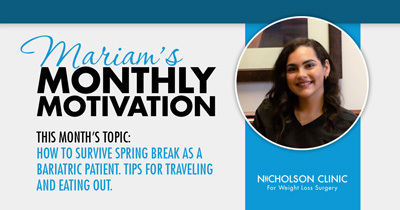
Happy March everyone! With March comes Spring Break which I feel like is one of those holidays that you either love or hate. Some parents are stressing over having their kids in the house all day for a week while some of you are just excited for a break or vacation. (Or you’re like me and just dreading how busy everywhere is going to be this week). Whatever it may be, I’m here to give you a few tips and tricks to survive Spring Break as a bariatric patient.
Let’s start with those of you living life up who may be going on vacation or spending the week away from your house. Being on the go, it’s so easy to get caught up in the fun or chaos that’s going on around you and make poor health choices. I know when I went to Disney, the last thing on my mind was healthy living. I was having too much fun. The fun stopped when I got back home and felt horrible the whole weekend. I’m going to try to help you avoid that scenario and have an amazing Spring Break.
Here’s a few tips:
- Mentally plan out your week of eating before hand if possible.
If you know you’re going to a special dinner one day or want to splurge on a meal, factor it in early.- If you can, try to pack your meals or at least non-perishable snacks you can keep in your bag when out and about like sugar free jerky, protein bars, nuts, etc. Raw vegetables and nut butters are great snacks, as well.
- When eating out, ask for a takeaway box at the start of your meal and put away half immediately for later.
- If you’re sharing a meal with a partner, place how much you can realistically eat on a separate, smaller plate.
- Try to choose choices based off of the protein first, vegetables second, and carbs last bariatric rule. So, if you want a burger, ask for it lettuce wrapped with a couple fries or half a bun.
- You’re on vacation, have the fries! This is a lifestyle change, not a diet. For a way of eating to be sustainable, it has to be somewhat enjoyable. If you’re out with family wishing you could have a bite of your kids’ chicken or partner’s burger while you’re eating a salad, it won’t be very enjoyable. You CAN fit your favorite foods into a healthy eating pattern. You just have to figure out a way to balance it. This is where the pre-planning can help.
- Water, Water, Water!!
- If at all possible, try to bring a gallon jug or bottle with you everywhere you go.
- Hydrate throughout the day to avoid fatigue and false hunger.
- Wake up to one glass of water and finish your day with another glass. This is a guaranteed 2 cups of water daily. Being busy, it’s easy to forget to drink. Try to be diligent with this.
- Eat within an hour of getting out of the bed. This is just a tip I’ve found works for me while on vacation. I find when I skip or put off breakfast, I eat more throughout the day and snack more often. It’s so important to fuel your body and start the day out with protein.
For those of you staying home, things will be slightly different. Staying at home with kids can sometimes make you want to down a whole bottle of wine for dinner. Don’t do it, think of the calories. 😊 But seriously, often times when we’re stressed or just sitting at home, we have the tendency to end up in the fridge or mindlessly snacking. Try to keep busy and active. Getting the kids out for a walk serves two purposes: it’ll run them down and wear them out, and it’s also great exercise that keeps you out of the kitchen.
I hope you all have a safe and happy Spring Break and I hope to see you all at the P2P Q&A session on 3/8/2022 at 6:30pm on our Nicholson Clinic Support Group Page on Facebook.
Are you preparing for weight loss surgery? Nicholson Clinic is committed to helping patients throughout their weight loss journey for life. In this blog post, you will learn what weight loss surgery recovery is all about and how to make the positive effect of weight loss surgery last.
Gastric Sleeve Surgery Recovery Timeline
Many patients who have Gastric Sleeve Surgery can go home the same day, resume work after four to five days, and return to a desk job after 10 to 11 days.
Gastric Bypass Surgery Recovery Timeline
With Gastric Bypass, most patients are home the next day, can work from home after about four to five days, and could be back at a desk job in about 1 ½ – 2 weeks.
With both procedures, patients must adhere to a post-operation diet. The Nicholson Clinic provides detailed instructions and offers comprehensive support, but you need to do your part to carefully follow the guidelines provided.
Diet
From the time you get home from the hospital to three weeks after your day of surgery, a full liquid diet is required (beverages, broths, protein drinks). Please review the Post-Operative Diet specific to your procedure. It is also important to stay hydrated by sipping at least 64 ounces of fluid per day.
When to Start Stage 1
You will need to start this diet the day you come home from the hospital. The first three weeks postoperatively are crucial for minimizing complications and maximizing your recovery.
Adherence to the post-operative diet will set you up for success and protect against a potential leak along the staple line of your new, smaller stomach. Following a full liquid diet for the first 21 days after surgery will give your body time to heal. This diet will also help you begin to understand how much food you can eat BEFORE you feel too full.
This is a time of learning new behaviors and developing new lifestyle habits.
The main 3 goals during Stage 1 of the diet are to:
- Rest the stomach and allow it time to heal.
- Stay hydrated by consuming ≥ 64oz fluid per day.
- Consume adequate amounts of protein to aid in the healing process.
*Do not worry about calorie intake at this time as your body will turn to your stored fat to obtain the energy that it needs to function.
When to Start Stage 2
Start this diet at Post-Op Day 22 and continue for 3 weeks. This is still time learning about your new body. Let your pouch be your guide on portion sizes. Stop eating BEFORE you feel full. Remember to use a food scale to weigh your food. Overeating and not chewing your food thoroughly can lead to nausea, vomiting, and stretching out your stomach.
*Start with softer foods like yogurt then transition into soft solid foods like ground turkey by the 3rd week. It is recommended to introduce new foods at dinner time.
Vitamins
All patients should take daily vitamins for a lifetime to avoid nutritional deficiencies.
Chewable, liquid or crushed forms of vitamins are preferred for the first 6 weeks during the liquid and soft diet phase, then you can transition to tablets or capsules at that point.
Over the counter multivitamins must be complete and should contain iron. Multivitamins should contain at least 200% Daily Value for most contents.
Specialized Bariatric multivitamins may prevent the need for additional vitamin D or B supplementation.
Activity
Once you are home from the hospital, you may return to daily activities such as showering, dressing, walking, etc. Do not get into a tub, hot tub, or swimming pool for 6 weeks or until all scabs have healed and fallen off. Keep the incision sites clean and dry. Gently clean your incisions with soap and water and gently pat dry.
Avoid lifting anything over 10 pounds until cleared by the surgeon. You may drive in 3-4 days as long as you are not taking any narcotic pain medication and you are able to turn your neck/head to see behind you. Sexual activity may be resumed as you feel able.
Post-Operative Appointments
It is important that you return to our office for long-term care. Your commitment to follow-up appointments, educational sessions and support group attendance will serve to ensure optimum health and success during your weight loss journey. Patients will receive our recommended Post-Operative appointment schedule and should continue to follow it. Remember that you are welcome to contact us at any time, from any location, for any reason, for the rest of your life!